Puzzle guides
How to play Cat Logic: rules and beginner strategies
Learn Cat Logic's row, column, region and no-touch rules, then use elimination, X marks and explained hints to work through your first cat puzzles.
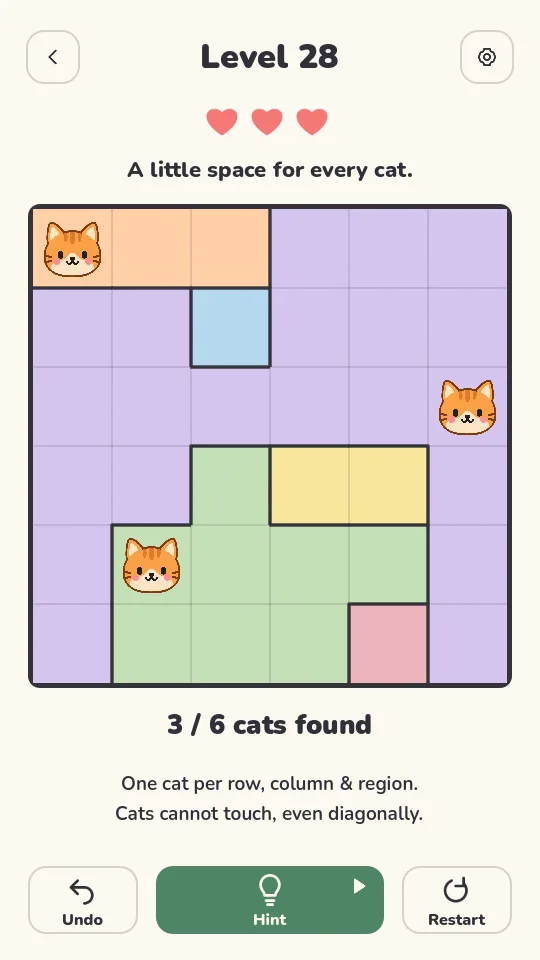
Cat Logic asks you to fill a colorful grid with ginger cats. The challenge is deciding where each cat belongs: every placement must satisfy a row, a column, a colored region and a rule about keeping cats apart.
This guide explains the rules and a repeatable way to approach a board. Follow the screenshots to practice marking impossible squares, placing cats and using the clues from each row, column and region.
Start with the four placement rules
A completed board has exactly one cat in each row, exactly one in each column and exactly one in each colored region. Those conditions apply together. A square that works for its row can still be wrong because its region already has a cat.
Cats also cannot touch. That includes diagonals: after placing a cat, the eight immediately surrounding squares are unavailable, wherever those squares exist on the board. A different region color does not create an exception.
- One cat in every row.
- One cat in every column.
- One cat in every colored region.
- No cats in neighboring squares, including diagonals.
Mark impossible squares before placing a cat
Tap a square to mark it with an X. Double-tap to place a cat. Use X marks to keep track of squares you have ruled out, so you do not have to repeat the same reasoning every time you scan the board.
When you place a cat, review its whole row, whole column and whole colored region. Each is now satisfied, so its other squares cannot contain another cat. Then check the neighboring squares for the no-touch rule.
Think of an X as a conclusion you can explain. Filling the board with uncertain marks makes it harder to see what you actually know. If a later step stops making sense, use undo and revisit the last conclusion.
Look for the row, column or region with one option
After marking exclusions, scan for a row, column or region with only one available square. That square must hold its cat. Place it, apply the exclusions again and repeat the scan.
You can also reason without placing anything. If every remaining square of a region lies in one row, that region's cat must use that row. Squares in that row outside the region are therefore unavailable. The same idea works for columns.
For example, suppose a colored region has two possible squares, both in the second row. You may not yet know which square holds the cat, but you do know the second row's cat belongs to that region. Mark the other squares in that row and see what that reveals elsewhere.
Use a hint to understand the next step
Cat Logic's hints explain a logical step rather than only filling a square. Before asking for one, choose the part of the board that is confusing you. Read the explanation, then look for the same relationship in another region.
Wrong placements cost hearts. If an attempt ends, retrying is free. There is no timer, so take the time to check all four rules before committing to a square. Undo lets you revisit a move, while explained hints help you understand the next logical step.
Build a routine as the boards grow
The campaign begins with 4×4 boards in levels 1–8, moves to 5×5 in levels 9–20, then 6×6 in levels 21–60 and 7×7 in levels 61–100. Bigger boards give you more relationships to track, but the rules stay the same.
Use the same loop throughout: scan, mark, place, check. The daily puzzle offers another board from a rotating local collection of 365 puzzles. Campaign progress and unfinished puzzles are stored on the device, so you can return to a board later.